
Florence did not become a city of artists and then take up goldsmithing. It happened the other way round. The bench came first, and a great deal of what the world calls the Renaissance was made by men who had learned to work metal before they learned anything else.
The guild
Medieval Florence was run by its guilds, and the goldsmiths belonged to one of the seven greater ones: the Arte della Seta, also called the Arte di Por Santa Maria after the street that runs from the Mercato Nuovo down to the Ponte Vecchio. Silk merchants and goldsmiths under one roof — the two trades that handled the most valuable things made in the city.
The guild set the standards, tested the metal, and decided who was allowed to call himself a master. An apprenticeship was long and it was not sentimental: you swept the workshop for years before anyone let you near the gold.
The artists who began as goldsmiths
Lorenzo Ghiberti and Filippo Brunelleschi were both trained goldsmiths, and in 1401 they faced each other in the competition for the bronze doors of the Baptistery. Ghiberti won. Brunelleschi, the story goes, left for Rome — and came back to build the dome.
Andrea del Verrocchio trained as a goldsmith too, and his workshop became the most important school in the city. A boy from Vinci called Leonardo learned his trade in it.
A goldsmith learns proportion at a scale where a tenth of a millimetre shows, learns to model in wax, to cast, to chase a surface until the light behaves. It is the best possible training for a sculptor, and an unusually good one for an architect.
Benvenuto Cellini
Cellini (1500–1571) was a Florentine goldsmith who became a sculptor, and who wrote one of the most entertaining autobiographies ever set down by an artist — boastful, violent, and impossible to put down.
The best scene in it is the casting of the Perseus, the bronze that still stands in the Loggia dei Lanzi. The metal was going cold in the furnace and the cast was about to fail. Cellini, feverish and shouting, had his household pewter — plates, bowls and dishes, about two hundred pieces by his own count — thrown into the melt to bring it back. It worked. Whether it worked quite as he tells it, no one can say; but the statue is there, and you can walk past it in ten minutes from here.
His bronze bust stands in the middle of the Ponte Vecchio. The goldsmiths of the bridge commissioned it in 1900, for the fourth centenary of his birth, from the Florentine sculptor Raffaello Romanelli. It is still the place where Florentine goldsmiths meet.
Five dates
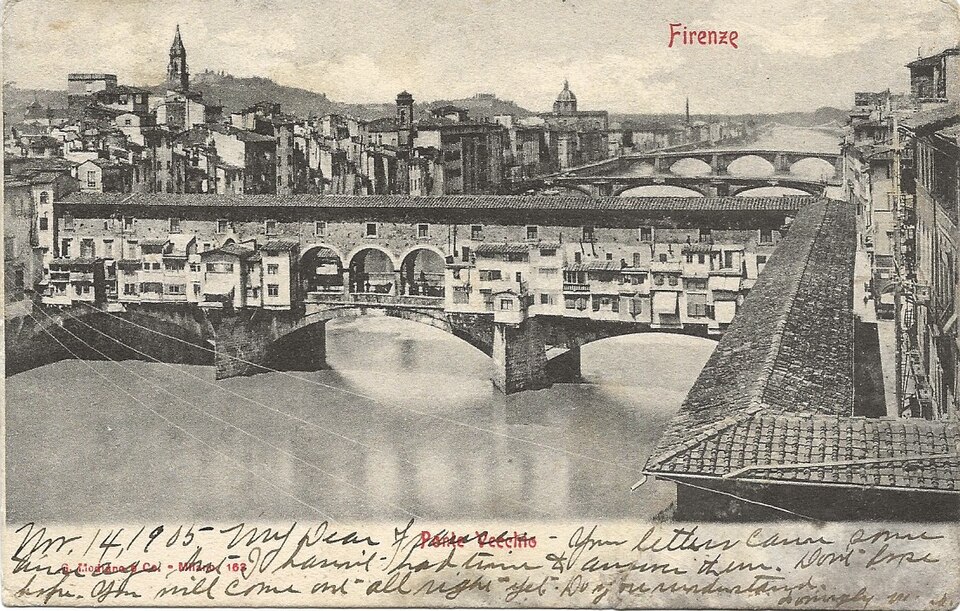
For most of its life the Ponte Vecchio smelled appalling. The shops on it belonged to butchers, fishmongers and tanners, who were there precisely because the Arno below carried the waste away. Walking over a meat market every day proved less agreeable than the Medici had expected — and in 1593 the trade on the bridge changed for good.
What the hand still does
Machines do a great deal now, and they do it well. But the finish on a good piece is still decided by hand, with tools that would be recognised by a man working in 1450.
Cesello
chasing
The metal is not cut away but pushed, with small punches and a light hammer, until the surface carries a relief. Nothing is removed; it is moved.
Bulino
burin engraving
Here metal is removed, in a single clean furrow. The cut catches the light in a way an etched line never does, and there is no undoing it.
Satinatura
satin finish
A fine abrasive breaks the mirror polish into a soft, directional sheen. It is what makes gold look warm rather than flashy — a matter of judgement, not of setting.
All of it is worked in 750 gold — the Italian standard, eighteen parts in twenty-four. What that number means, and how to read the second mark stamped beside it, is a guide of its own.
A short walk, Ponte Vecchio to Santa Croce
Twenty minutes if you do not stop, an hour if you do. It is the old goldsmiths’ quarter, and it ends at our door.
Ponte Vecchio. Stand at the middle, by the Cellini bust, and look up: the Vasari Corridor runs over your head.
Via Por Santa Maria. The street that gave the guild its name, running north from the bridge.
Mercato Nuovo. The loggia with the bronze boar. Silk and gold were traded here.
Piazza della Signoria. Into the Loggia dei Lanzi for Cellini’s Perseus — the one he saved with the pewter.
Piazza Santa Croce. Ten minutes east. We are at number 30/R, on the south side of the square — open it in Google Maps.
Still at the bench
A family of goldsmiths since 1972, on Piazza Santa Croce since 1984 — father and sons, the same trade, a few hundred meters from the bridge where it has been practiced for four hundred years. Rings sized, chains shortened, a pendant built around a stone: the work still happens here, by hand, while you wait. Come and see the bench. We are usually working at it.
Cellini Gold
Piazza Santa Croce 30/R, Florence
Open every day, 10:00 – 18:00
Checked November 2026. The goldsmiths belonged to the Arte della Seta, also called the Arte di Por Santa Maria, one of the seven greater guilds of Florence. The 1593 decree of Ferdinando I and the 1565 Vasari Corridor are two distinct events and are often confused with one another. The bust of Cellini was commissioned in 1900 by the goldsmiths of the bridge from Raffaello Romanelli, for the fourth centenary of Cellini’s birth. The pewter thrown into the furnace during the casting of the Perseus — about two hundred platters, porringers and dishes — is told by Cellini himself in his autobiography.