
Pick up a piece of Italian gold and turn it over. Somewhere on it — inside a ring, on the clasp of a chain — there are two tiny marks. One is a number: 750. The other is a small lozenge with a star in it. Together they tell you what the metal is and who made it, and in Italy they are not optional: the law requires both.
What 750 means
Pure gold is too soft to wear. It bends, it scratches, a setting made of it would not hold a stone. So gold is alloyed, and the stamp tells you how much gold is actually in the metal — measured in parts per thousand.
750
the stamp
750 parts of gold in every 1,000. That is 75% pure gold, and 75% of 24 is 18.
So 750 = 18kt. Same metal, two ways of writing it. Italy stamps the number; Britain and America usually say the karat.
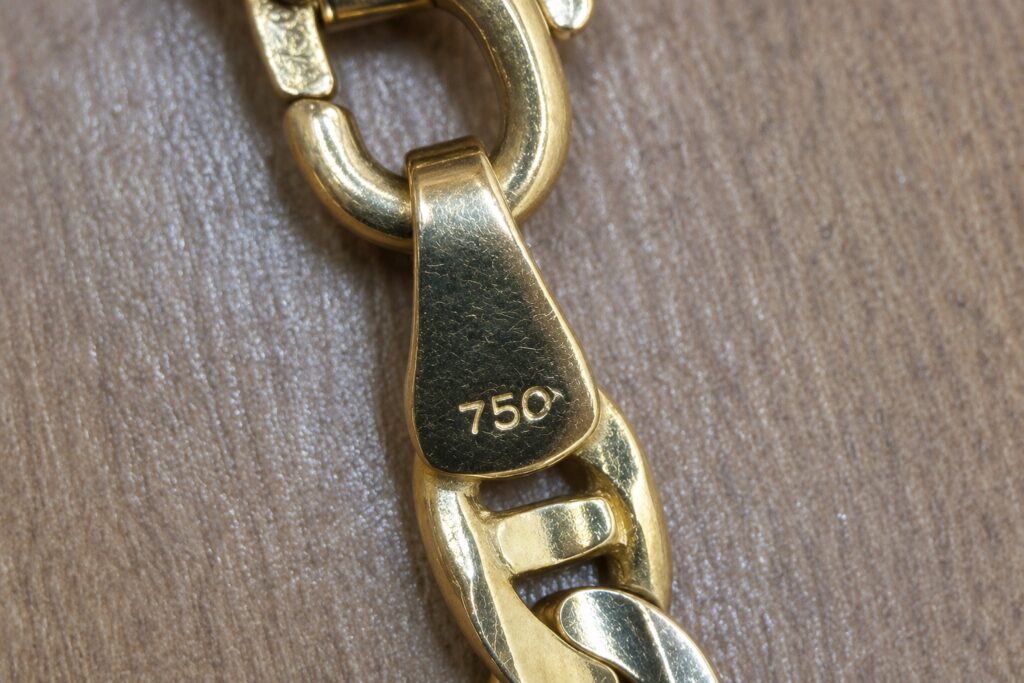
Bring a loupe, and bring patience
The photograph above is magnified. In the hand that stamp is about a millimetre tall, and it is often harder to find than this page makes it sound. On small pieces — a thin ring, a pair of studs, a fine chain — there may be very little flat metal to strike, so the mark is tiny, shallow, and tucked wherever the goldsmith could fit it: inside the shank, on the edge of a clasp, on the post of an earring. Years of wear soften it further, and polishing can almost erase it.
So take your time. Turn the piece slowly under a lamp until the light catches the engraving sideways — that is when a worn stamp appears. A faint mark is normal and is not a warning sign. No mark at all, on a piece sold as gold, is a question worth asking out loud.
The karat scale is simply twenty-fourths. 24kt is pure gold, 18kt is eighteen parts gold to six parts of something else, 9kt is nine parts to fifteen. A karat is a proportion, not a weight: of two chains that weigh exactly the same, the 18kt one holds three quarters of its weight in gold and the 9kt one holds three eighths. Weigh first, then read the stamp — you need both numbers to know what you are buying.
Why Italy settled on 18kt
Italian law recognises three legal standards for gold: 750, 585 and 375 thousandths — 18kt, 14kt and 9kt. All three are legal. Almost everything you will see in a Florentine window is the first one. There are three reasons for that, and they pull in the same direction.
It is the top of the scale
750 is the highest standard Italian law allows for a finished piece. A workshop that wants to make the best thing it can has nowhere else to go.
It behaves at the bench
At 75% gold the metal still takes a high polish and a crisp engraved line, but it is hard enough to hold a stone and survive being worn every day. Higher, and it goes soft; lower, and the color drains out of it.
It keeps the color
That warm Italian yellow is a function of how much gold is in the alloy. Put in less and the copper and silver start to show: 9kt reads pale and slightly gray next to 18kt, side by side in daylight.
The habit hardened into an industry. The Italian goldsmithing districts — Arezzo, Vicenza, Valenza, and the workshops of Florence — grew up exporting fine jewelry at 750, and the whole trade here is set up around it: the alloys, the solders, the findings, the way a chain is drawn. Ask for something in 9kt in Florence and you will get a puzzled look, not because it is worse law but because nobody here is tooled for it.
The other 25%
The gold content of 18kt is fixed. What goes in beside it is the goldsmith’s choice, and it is what gives you the three colors — all of them 750, all of them equally gold.
Yellow — copper and silver in roughly equal measure. The classic, and the Italian default.
Rose — more copper, less silver. Warmer, and a little harder than yellow.
White — whitened with palladium or silver, and usually finished with a thin rhodium plating for brightness. The plating is a surface, and after years of wear it can be renewed.
The second mark: who made it, and where
This is the part most visitors never notice, and it is the useful one. Alongside the 750, Italian law requires a marchio di identificazione — an identification mark. It is not a brand or a logo. It is a registered mark, and it is traceable.
★ 123 FI
A lozenge, a five-pointed star, the number assigned to the workshop, and the abbreviation of the province where it is registered.
FI is Florence. AR is Arezzo, VI Vicenza, AL Alessandria — the province of Valenza — MI Milan.
The number is not chosen by the maker. It is assigned by the Chamber of Commerce of the province, and the workshop is entered in a public register of mark holders. Which means a mark is checkable: with the number and the province, anyone can write to that Chamber of Commerce and be told which company it belongs to and where it is registered. There is no charge for asking.
So the two marks answer two different questions. 750 tells you what the metal is. The lozenge tells you who is answerable for it.
What “made in Italy” does and does not tell you
“Made in Italy” on a label is a claim about origin. The lozenge is a claim about a specific company, in a specific province, on a register. They are not the same thing, and when the two disagree it is the stamped mark that is worth more than the label.
A piece can be perfectly legitimate and still have been designed in one place, cast in another and finished in a third — that is how most of the trade has always worked, in Florence as everywhere else, and there is nothing wrong with it. What matters is that someone registered is answerable for the metal, and that the shop selling it to you knows exactly who that is. Ask. A good shop will tell you without hesitating.
The same gold, written three ways
Italy
Three legal standards: 750, 585, 375. The number is stamped, not the karat, and an identification mark must be stamped beside it.
United Kingdom
Hallmarking by an assay office is compulsory above the exemption weights, and 9ct is a long-standing British standard — which is why a British visitor often finds Italian gold deeper in color than what they are used to.
United States
No national assay office and no compulsory hallmark. Under the Federal Trade Commission’s Jewelry Guides, wherever the word gold is used it must be immediately preceded by the karat fineness, in equally conspicuous type — which is why an American piece reads 14K GOLD rather than carrying a stamped number on its own. 14kt is the common retail standard; 18kt is the step above it.
Four things to check at the counter
Ask to see the marks. Both of them. A loupe lives on every goldsmith’s bench and you are entitled to borrow it.
Check that the number on the receipt matches the metal you were quoted. 750 and 585 are not the same purchase, and the price per gram should not be either.
Gold-plated is not gold. Plating is measured in microns on a base metal and carries no 750 stamp. If there is no stamp, ask why.
Keep the paperwork. You will want it for insurance, for any future repair, and — if you live outside the EU — for your tax free refund at the airport.
Ask to see the marks
Everything in our window is Italian gold at 750, and every piece carries both marks: the title, and the lozenge of the workshop that struck it. Come in and ask. We will put the loupe in your hand, show you where the marks sit on that particular piece, and read them with you — the number, the star, the two letters of the province. It takes a minute, and it is the difference between taking someone’s word for it and seeing it for yourself.
Cellini Gold
Piazza Santa Croce 30/R, Florence
Open every day, 10:00 – 18:00
Checked November 2026. The legal standards for gold in Italy (750, 585 and 375 thousandths) and the requirement that an object carry both its title and an identification mark are set by Legislative Decree 251 of 22 May 1999, articles 3 and 4; the composition of the identification mark and the assignment of the number by the Chamber of Commerce are in article 8 and in the implementing regulation, Presidential Decree 150 of 30 May 2002. The United States position is from the Federal Trade Commission’s Guides for the Jewelry, Precious Metals, and Pewter Industries (16 CFR Part 23).